About Beyond the Argument
Understanding What Is Happening Beneath the Surface
For most of my life, I have been fascinated by one question:
How can people who genuinely love each other end up hurting each other so deeply?
That question has guided far more than my career—it has shaped my life’s work.
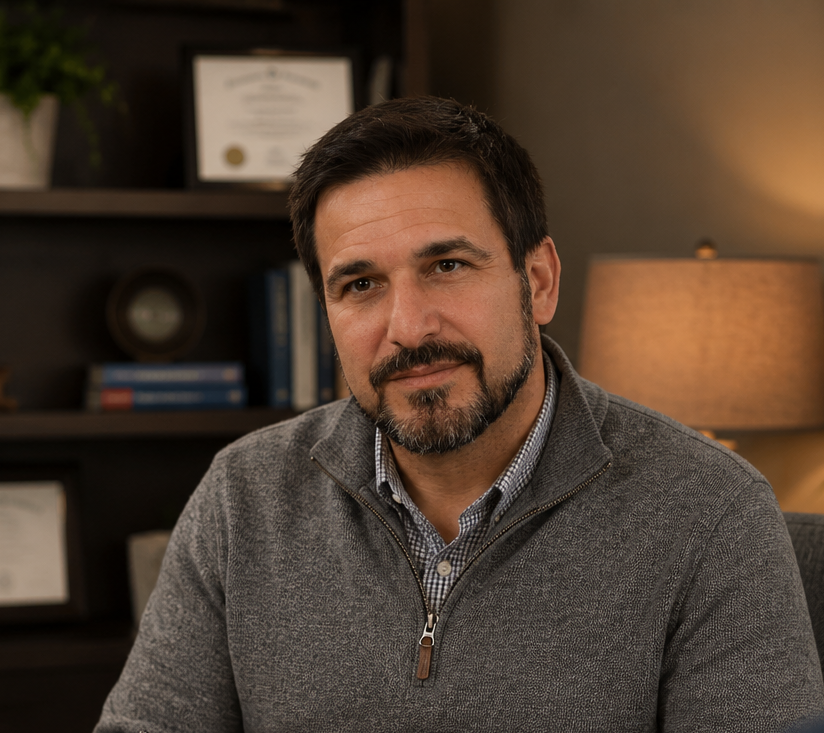
Over the years, my search for answers has taken me through a broad education, beginning with a bachelor’s degree from Hope College, continuing with a Master of Divinity from Trinity Evangelical Divinity School, and eventually leading to a Master of Professional Counseling from Liberty University.
Each experience contributed something different: a deeper appreciation for people, a respect for the complexity of the human mind, and the clinical insight needed to help individuals and couples pursue meaningful, lasting change.
For more than ten years as a counselor, I have had the privilege of sitting with hundreds of people during some of the most painful and confusing moments of their relationships.
What I have discovered is both encouraging and important:
Most Relationship Problems Are More Complicated Than They Appear
People do not always struggle because they do not love each other.
They often struggle because they do not fully understand themselves, one another, or the deeper patterns shaping their relationship.
They may not recognize:
- How past experiences influence present-day reactions
- How fear can disguise itself as anger, certainty, control, or withdrawal
- How protective patterns quietly shape difficult conversations
- How good intentions can still create painful consequences
- How each person’s mind constructs a different version of the same experience
- How quickly a disagreement can activate insecurity, defensiveness, or the fear of being misunderstood
When these deeper forces remain invisible, couples frequently repeat the same painful conversations—each person becoming more convinced that the other is the problem.
But when people begin to understand what is happening beneath the argument, new possibilities emerge.
Curiosity can begin replacing certainty.
Responsibility can replace blame.
Compassion can grow without requiring either person to excuse harmful behavior.
And change becomes more possible because the real problem is finally being addressed.
Find Out More
If you're wondering whether Beyond the Argument is right for you, feel free to reach out. I'll personally respond within 24 hours and help you determine the next step.
Why I Created Beyond the Argument
Beyond the Argument began as a couples communication program, but the framework grew into something broader.
The same underlying principles can help people facing very different relationship circumstances. A marriage in crisis requires a different kind of support than a relationship recovering from betrayal. A person whose partner refuses to participate has different decisions to make than a couple learning together. Loving someone struggling with addiction presents challenges that cannot be addressed through ordinary communication advice alone.
That is why Beyond the Argument now offers five distinct programs:
Beyond the Breaking Point Program
For men facing separation, divorce, or the fear that their wife may already be emotionally finished with the marriage.
This program helps men respond to the crisis with greater clarity and emotional steadiness, recognize approaches that may be creating additional pressure, and focus on the kind of genuine personal change that can be seen and experienced—not merely promised.
Beyond the Betrayal Program
For individuals trying to determine whether trust can—and should—be rebuilt after betrayal.
This program helps participants process the complexity of what they are feeling, evaluate the evidence of meaningful change, define appropriate boundaries, understand the unavoidable element of risk, and make thoughtful decisions about reconciliation without being controlled by either fear or false reassurance.
The Beyond the Argument Couples Course
For couples who care about their relationship but keep getting caught in negative patterns, painful misunderstandings, defensiveness, withdrawal, or recurring conflict.
This course helps couples understand themselves and one another more accurately, communicate with greater depth, and address the patterns beneath their disagreements rather than repeatedly arguing about the surface issue.
The Self-Aware Partner Program
For the person who wants to improve the relationship—even when their partner is resistant, unavailable, or unwilling to participate.
This program helps individuals examine their own reactions, biases, boundaries, communication patterns, and difficult decisions without accepting responsibility for everything that is wrong. Its purpose is to help each participant become clearer, stronger, and more intentional, regardless of what their partner chooses to do.
Beyond the Addiction Program
For individuals who love someone struggling with substance use or another addictive pattern but can no longer continue living in confusion, instability, or emotional exhaustion.
This program helps participants preserve their identity, establish meaningful boundaries, communicate more clearly, build a healthier support system, and distinguish loving someone from protecting them from every consequence of their choices.
Each program addresses a different form of pain, but all five are grounded in the same conviction:
Lasting change begins when we understand the deeper forces shaping our thoughts, emotions, reactions, and relationships.
Explore the ProgramsThe Psychology Behind the Framework
Rather than offering another collection of communication tips, I wanted to create a framework that helps people understand why communication becomes so difficult in the first place.
Much of this framework is informed by two approaches that have profoundly influenced my work: Eye Movement Desensitization and Reprocessing, commonly known as EMDR, and Internal Family Systems, or IFS.
EMDR provides insight into how earlier experiences can continue shaping present emotions, beliefs, sensitivities, and expectations. It helps explain why a present-day disagreement can awaken pain that feels much larger than the immediate situation.
Internal Family Systems helps us recognize that the human mind is not as simple or internally consistent as we sometimes assume. Each of us has different protective parts—parts that criticize, defend, avoid, control, withdraw, perform, please, or seek reassurance.
These parts generally develop for understandable reasons. They are often trying to protect us from rejection, failure, shame, helplessness, or emotional pain.
But a protective response can still create the very outcome it is trying to prevent.
The part that pressures for reassurance may push a partner farther away.
The part that withdraws to avoid conflict may leave the other person feeling abandoned.
The part that becomes defensive to protect against shame may prevent genuine accountability.
The part that tries to control an uncertain situation may make the relationship feel less emotionally safe.
Understanding these internal patterns does not excuse hurtful behavior. It allows us to address that behavior more accurately and effectively.
Understanding Is Not the Same as Excusing
One of the most important principles within Beyond the Argument is that understanding and accountability belong together.
Understanding why someone behaves a certain way does not mean pretending the behavior is acceptable.
Compassion does not require the abandonment of boundaries.
Recognizing another person’s pain does not mean ignoring your own.
And acknowledging your contribution to a pattern does not mean accepting responsibility for everything that has happened.
The goal is not to decide that no one is at fault. The goal is to move beyond oversimplified blame so that each person can see more clearly what is theirs to acknowledge, change, repair, or decide.
That balance is especially important when a relationship involves betrayal, addiction, emotional resistance, or the possibility of separation.
More Than Academic Knowledge
This work is also shaped by something no degree alone can provide.
After nearly six decades of observing people, relationships, success, failure, faith, and my own continuing growth, I have become convinced that wisdom is less about accumulating answers and more about developing the humility to keep learning.
Some of the most important lessons I have learned did not come from a classroom.
They came from listening carefully.
Admitting when I was wrong.
Seeing my own blind spots.
Recognizing the limitations of my first interpretation.
And discovering that genuine growth almost always begins with curiosity rather than certainty.
I believe every person possesses inherent worth, and that healthy relationships are built through honesty, humility, compassion, responsibility, courage, and grace.
Those values are woven throughout every Beyond the Argument program.
My Purpose
My purpose is not to promise that every relationship can—or should—be preserved.
It is not to tell people what decision they must make.
And it is not to offer quick communication techniques for problems that are far more complex.
My purpose is to help people:
- Understand themselves more accurately
- Understand others more generously without becoming naïve
- Recognize the patterns keeping them stuck
- Communicate with greater clarity and emotional maturity
- Take meaningful responsibility without carrying responsibility that is not theirs
- Establish boundaries rooted in wisdom rather than panic
- Make difficult relationship decisions with greater confidence
- Become more intentional about the person they want to be
Sometimes that work helps a couple reconnect.
Sometimes it helps rebuild trust after serious damage.
Sometimes it helps one person change the part of the relationship they can influence.
And sometimes it provides the clarity and strength needed to face a difficult reality.
Whatever the situation, the work begins in the same place:
Stop trying to win the conversation.
Start understanding what is really happening beneath it.
Find the Right Path Forward
You may be fighting to save your marriage, deciding whether trust can be rebuilt, trying to stop the same arguments, working on yourself without your partner’s participation, or struggling to love someone whose addiction is affecting your life.
You do not have to pretend the situation is simple.
The right program can help you understand what you are facing, identify what is within your control, and take your next steps with greater clarity, wisdom, and purpose.
Explore the Five ProgramsFind Out More
If you're wondering which program is right for you, feel free to reach out. I'll personally respond within 24 hours and help you determine the next step.